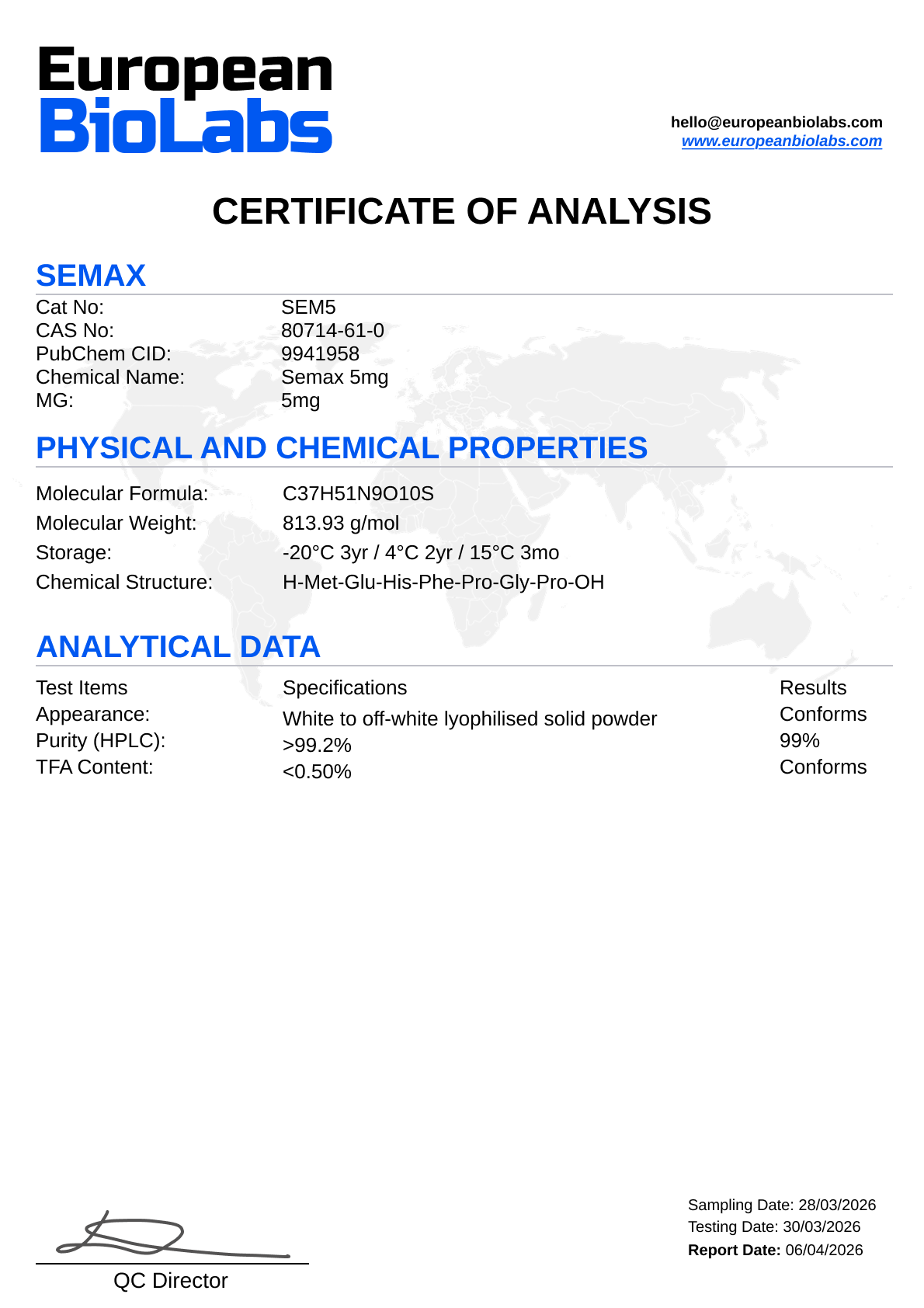
Description
Semax is a synthetic peptide originally developed from a fragment of ACTH — one of the brain’s stress hormones — with modifications that make it stable enough to reach the brain and act on neural tissue. It has been studied extensively in models of cognitive function, neurological recovery, and brain protection, particularly following ischaemic injury (reduced blood flow to the brain).
What the research has found
• Semax significantly increased BDNF (brain-derived neurotrophic factor) — often described as the brain’s own “growth factor” — in hippocampal and cortical neurons. BDNF is associated with neuronal survival, the formation of new connections between brain cells, and processes linked to learning and memory (Dolotov et al., 2006)
• In rodent models of stroke, Semax administered via the nasal route significantly reduced the size of brain injury and improved neurological recovery scores. These protective effects were associated with reduced inflammation in brain tissue and upregulation of cell survival genes (Filippenkov et al., 2020)
• Animal studies examining memory and learning tasks demonstrated measurable improvements in spatial memory performance following Semax treatment, consistent with its BDNF-mediated effects on synaptic plasticity (Eremin et al., 2005)
• Gene expression analysis showed Semax affects a broad set of brain pathways simultaneously — including neurotransmitter signalling, antioxidant defence, and anti-inflammatory mechanisms — suggesting a wide-ranging effect on neural tissue biology (Dolotov et al., 2006)
For research use only. Not intended for use in humans or animals.
References
Dolotov, O. V., et al. (2006). https://pubmed.ncbi.nlm.nih.gov/16460711/
Eremin, K. O., et al. (2005). https://pubmed.ncbi.nlm.nih.gov/15711979/
Filippenkov, I. B., et al. (2020). https://pubmed.ncbi.nlm.nih.gov/31845246/